Travis attempts to assassinate Palantine
Taxi DriverTravis Bickle's attempt to assassinate Charles Palantine is the moment when his wish to become somebody and enter history takes the form of a planned public killing. He approaches the senator at a campaign rally carrying a concealed .38 Special, but bodyguards notice him and steer Palantine away before he can fire. Travis flees. The event turns political spectacle into the setting for a private fantasy of fame, while exposing how little control Travis has over the historical role he imagines for himself.
Background and Motive
Travis's approach to Palantine grows out of the isolation and violence that have shaped his nights as a taxi driver. He describes New York City through a racist, degrading view of its people, and his account of the city repeatedly reduces social hardship to contamination and threat. At the taxi depot, Charley T. likewise makes racist remarks about people he sees and passengers he might encounter. These details do not make the attempted assassination a response to racial politics; they establish the prejudiced urban gaze through which Travis interprets the city and its inhabitants.
His work also gives him a route through places he regards as dangerous. After obtaining guns, he deliberately drives through Harlem and other neighborhoods, including around 128th Street and Amsterdam, telling himself that he needs to know what would happen if he had to use them. He reports that passengers there are polite and that there is no trouble, yet the rides become part of a private rehearsal: he wants to make his imagined future with a weapon feel real. The taxi, ordinarily a means of earning money and moving through the city, becomes a vehicle for testing his proximity to violence.
Travis explicitly imagines becoming a celebrity and entering history. He measures himself against notorious assassins and worries about remaining real enough to carry out his plan. His ambition is not framed as a sustained political program. Instead, he treats public notoriety as proof that he exists and that his life has acquired consequence. That hunger meets his fixation on Betsy, whom he had watched at Palantine's campaign headquarters and idealized as exceptional. Although Travis had admired Palantine and thought he might vote for him, he comes to imagine Betsy as worshipping the senator as an idol. He believes she would be terrified and disappointed by Travis, but calls the act a masculine feeling. In his mind, the assassination becomes at once a bid for historical visibility and a performance of manhood before an imagined audience of one.
The Rally and the Approach
The rally takes place in Harlem on a hot June day. From his taxi, marked as occupied, Travis hears Palantine address a crowd and speak against racism, poverty, war, and social division. Palantine calls for people to accept their neighbors and contribute to a common good; the audience applauds and answers him with approval. Travis listens only partly. His attention moves between the speech, the crowd, and the letter he imagines writing to his parents. The juxtaposition is central to the scene: a public appeal to shared civic life unfolds while Travis privately prepares an act that would endanger the speaker and turn that public gathering into a stage for his own notoriety.
Travis remains in his taxi as the speech proceeds, the only white man on the block apart from police, security personnel, and journalists. Sweat runs over the old scars on his body and into his mirrored glasses. Beneath his army jacket is the bulge of his Smith & Wesson .38. The details make his preparation tangible: the weapon is concealed, but its weight shapes the scene, and his attention to his scars, clothes, and posture makes his body part of the self-image he is trying to construct.
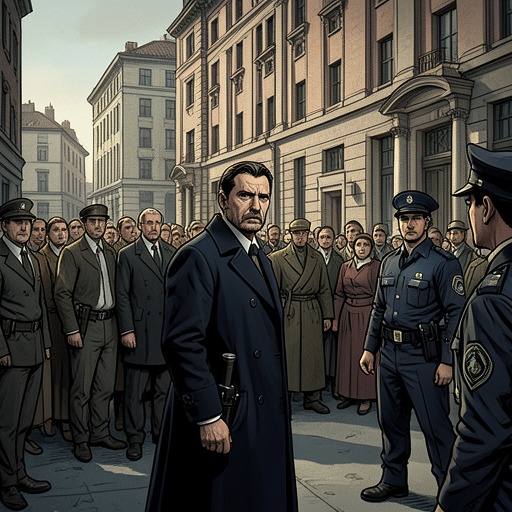
When he enters the gathering, the event expands into a carefully watched political spectacle. There are hundreds of journalists and supporters, dignitaries on gray wooden platforms, a Dixie jazz band, and bodyguards moving through the crowd. Travis sees a bodyguard he had spoken to roughly a week earlier near Palantine and Betsy's Tom. Betsy herself is nowhere in sight. He stays at the edge of the crowd, slightly hunched, with his hands in his pockets; he takes them out only to swallow pills. The crowd applauds Palantine, while Travis tries to remain inconspicuous and close enough to act.
Security Intervenes
As Palantine comes down the steps and moves through the crowd, Travis keeps one hand on the gun beneath his open jacket. He imagines the senator approaching him and describes the weapon as within reach. Then the bodyguards spot him. One signals another, they point Travis out, and security redirects Palantine away from him, working to part the crowd. Travis and the senator briefly meet one another's gaze as Palantine is led in a different direction. The encounter is therefore not a completed attack but a near-approach interrupted by security before Travis can draw and fire.
Travis turns and runs. He is sweating, and the bodyguards search for him as he reaches the taxi he alone knows how to find and drives away. The abrupt escape reverses the scene's imagined trajectory: he had approached the crowd hoping to become historically visible, but once discovered he abandons the attempt and concentrates on getting clear. The senator is not harmed, and Travis does not succeed in carrying out the assassination. His failure is caused not by a change of heart but by the guards' intervention and the disruption of his opportunity.
Significance and Aftermath
The attempt concentrates the contradiction in Travis's self-presentation. He regards Palantine as admirable and expects, in a fantasy, that the senator might recognize and even love him as an assassin. He also imagines the killing as a way to make himself real and to enter history. Yet his actions do not establish a coherent political opposition to Palantine: Travis's own account links the plan to personal recognition, to his imagined relationship with Betsy, and to a compensatory idea of masculinity. The public campaign supplies the audience and the stage; his private need supplies the drama he wants to enact there.
The rally's political language sharpens that contrast. Palantine speaks publicly about rejecting racism and poverty and accepting one's neighbors, while Travis's narration has already rendered the city's inhabitants through racist categories and contempt. The scene places these outlooks beside each other without making Travis a participant in the senator's appeal. He remains at the margin, watching and preparing to use violence. His attempt to seize a place in public life thus depends on threatening the very public gathering whose language of unity he only partly hears.
Later, after a separate episode of violence, Travis wakes in a hospital, is not sent to prison, and is presented in newspaper headlines as a hero who opposed the underworld. The delayed aftermath creates an irony around the failed attack on Palantine: Travis's bid to make himself famous through political assassination does not succeed, yet public attention and heroic status eventually arrive through another violent act. The two outcomes are distinct, but together they show how the recognition he sought becomes detached from his original plan and from the complicated motives he records.